The Birth of the Modern Comic Strip: Richard Outcault's The Yellow Kid and the Dawn of a New Medium
April 16, 2026 · 5 min read
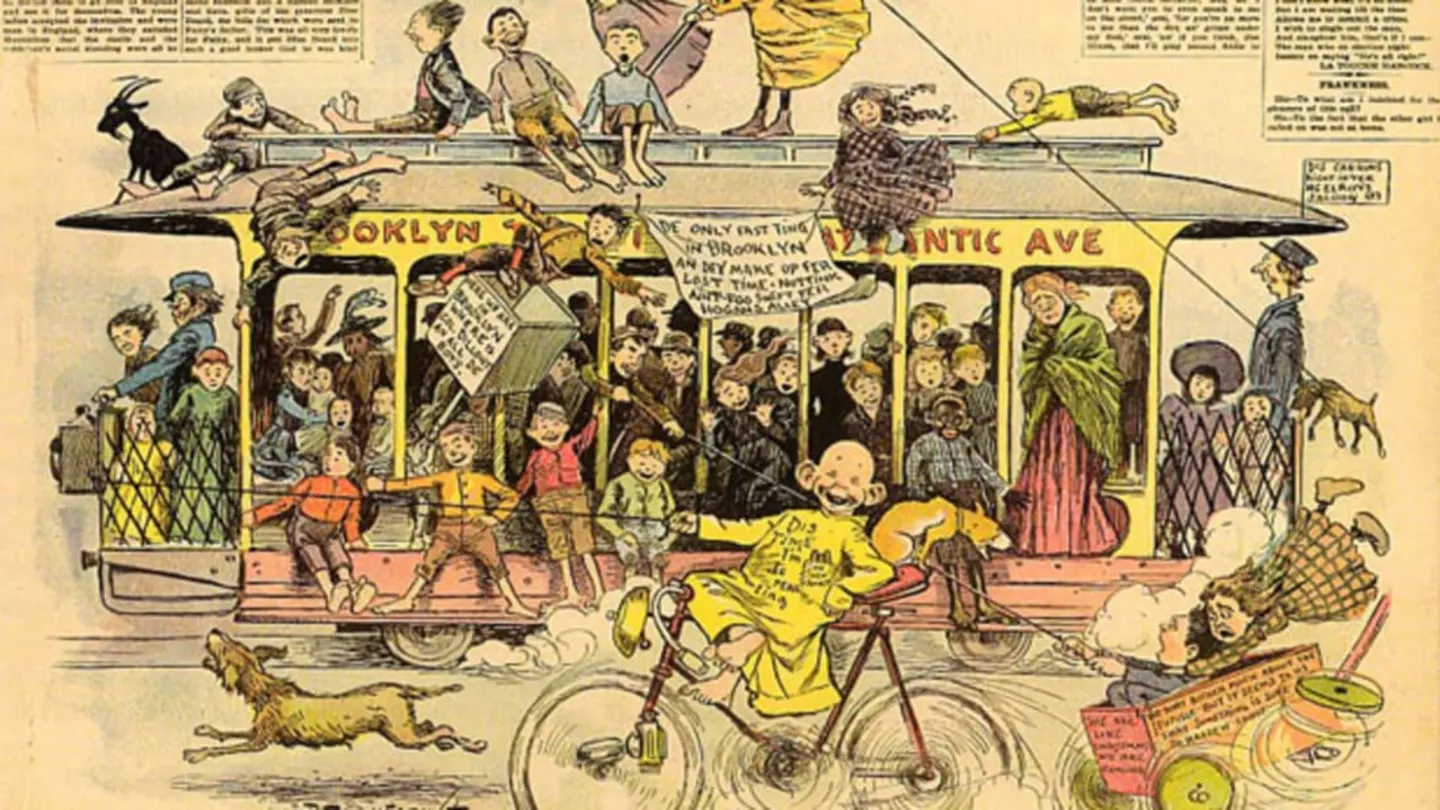
In 1895, the modern comic strip as we know it today was born in the pages of Joseph Pulitzer's New York World. Richard F. Outcault's creation — a bald, big-eared slum kid in a bright yellow nightshirt known as Mickey Dugan, or simply The Yellow Kid — became a recurring character featured week after week in colorful, large-format Sunday panels. This wasn't just a one-off cartoon; it was the spark that ignited the American comic strip industry and gave comics their very first "franchise."
Outcault, a technical illustrator turned cartoonist, had experimented with the character earlier. The kid first appeared in a minor supporting role in Truth magazine in June 1894 (in a single-panel cartoon titled Feudal Pride in Hogan's Alley). A more prominent version, Fourth Ward Brownies, ran in Truth on February 9, 1895, and was reprinted in the New York World eight days later on February 17. But it was on May 5, 1895, that the World introduced the full-color Hogan's Alley feature — a chaotic, densely populated scene of New York tenement life starring the Yellow Kid as the breakout character. Readers immediately latched onto the mischievous urchin and his ragtag gang of street kids.
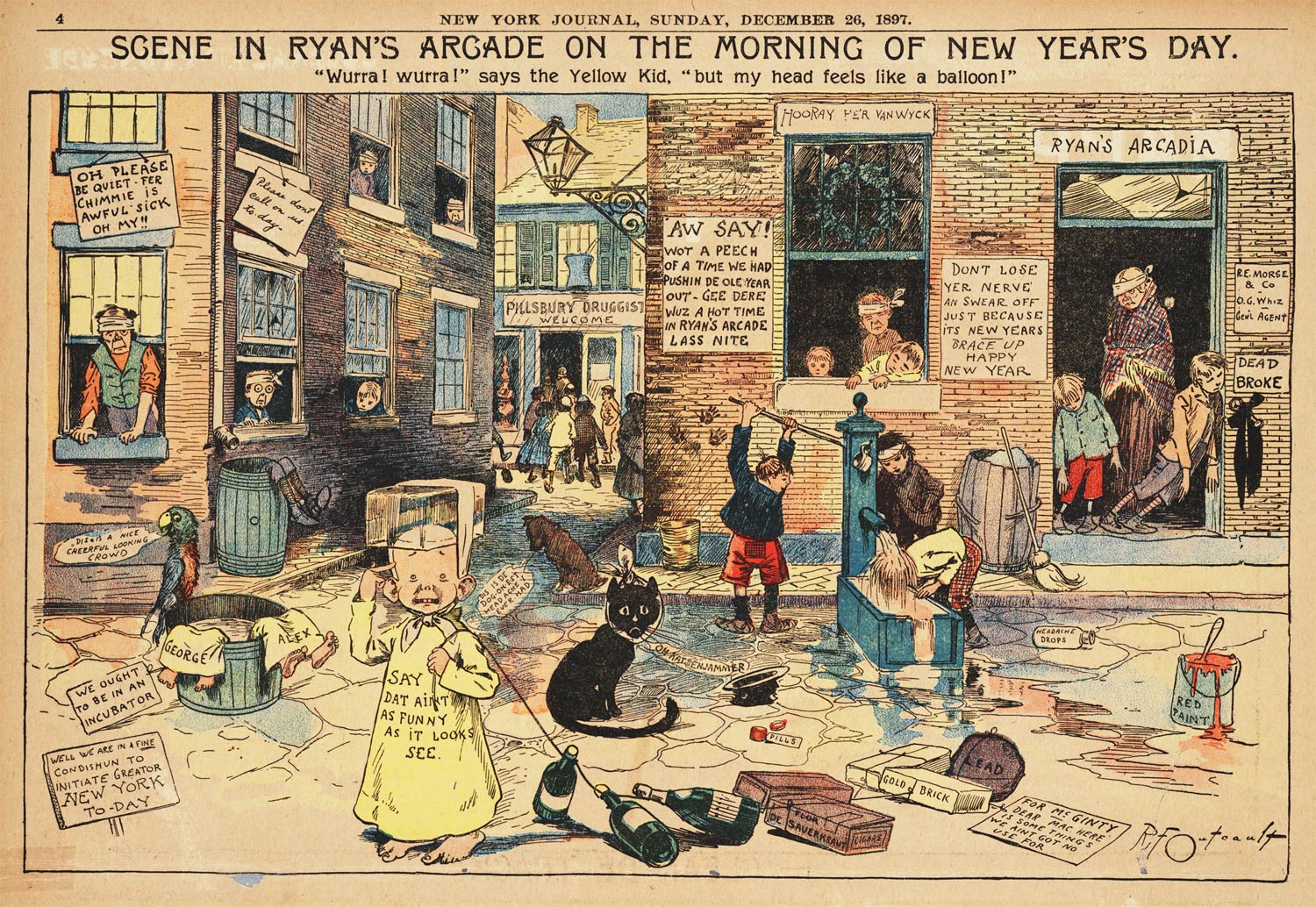
Early Hogan's Alley pages were typically single, oversized panels packed with satirical commentary on urban poverty, politics, and daily life. Dialogue appeared in captions or, innovatively, scrawled directly on the Yellow Kid's oversized yellow nightshirt — a precursor to the speech balloons that would soon become standard in comics. The feature quickly became the anchor of the World's new Sunday color supplement, helping drive newspaper sales in an era of fierce circulation wars between Pulitzer and rival publisher William Randolph Hearst.
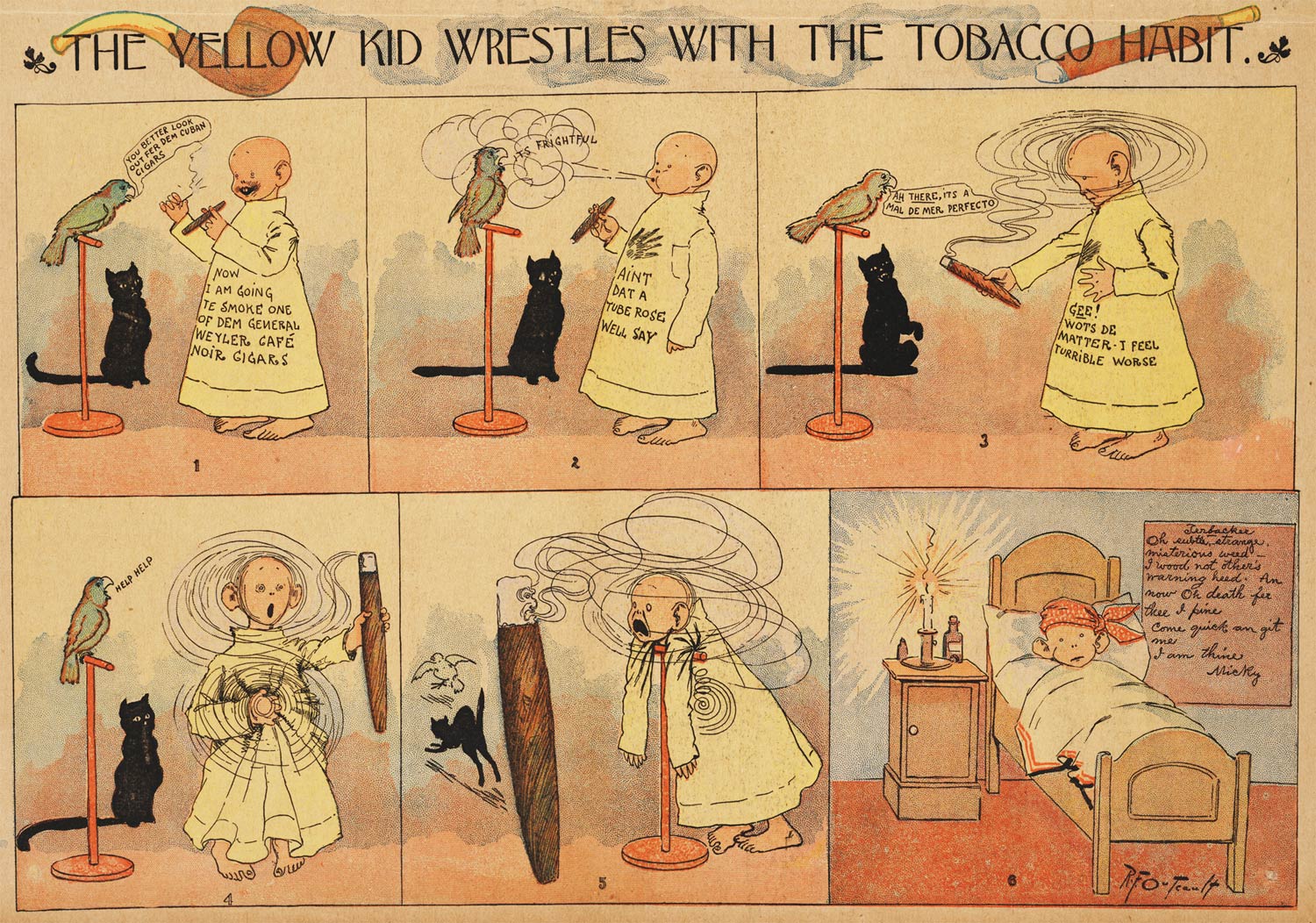
The Yellow Kid's popularity exploded. By mid-1896, the character was a cultural phenomenon. Outcault was lured away to Hearst's New York Journal in October 1896, where the strip was renamed McFadden's Row of Flats. On October 25, 1896, Outcault experimented with something groundbreaking: the first true multi-panel sequential narrative featuring the Yellow Kid. This shift from static single panels to a series of connected images telling a story in sequence marked a pivotal evolution in the form.
But Pulitzer wasn't about to let his star attraction go. He promptly hired artist George Luks to continue drawing Hogan's Alley (and the Yellow Kid) for the World. For a brief period in late 1896 and 1897, two competing versions of the exact same character ran simultaneously in rival newspapers — one by Outcault, one by Luks. This was comics' first franchise: the character had become bigger than any single creator or newspaper. Merchandise followed — everything from buttons and toys to stage shows and even a short-lived magazine — proving that a comic character could be a commercial powerhouse.
The Yellow Kid's success didn't just sell newspapers; it transformed the medium. It popularized recurring characters, color Sunday supplements, word balloons (or shirt-based dialogue), and serialized storytelling. Historians widely credit Outcault's creation with establishing the template for the American comic strip. The intense rivalry over the character even gave rise to the term "yellow journalism" — a reference to the sensational, crowd-pleasing style of the papers battling over The Yellow Kid.
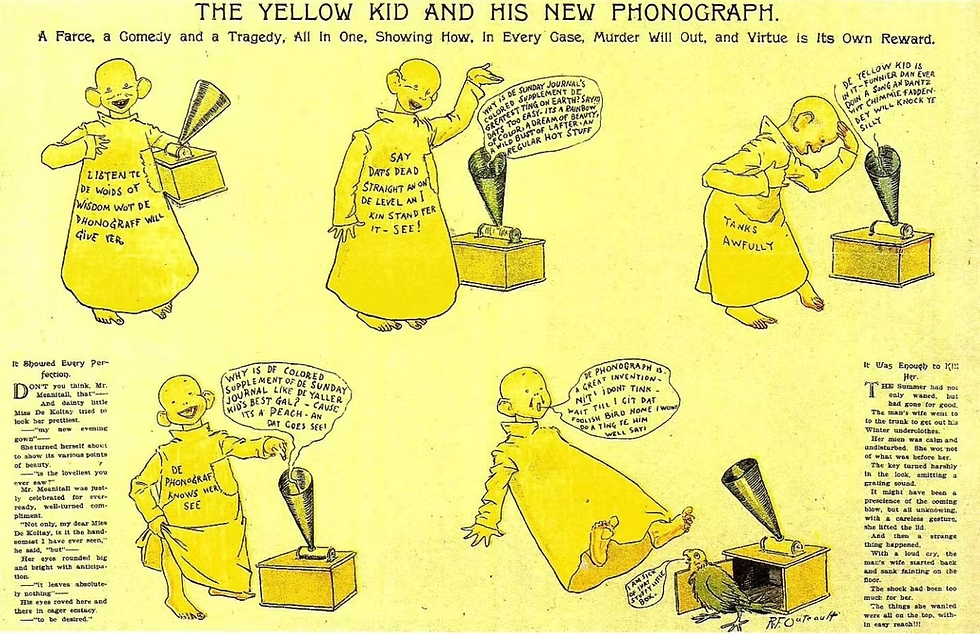
By 1898, Outcault had moved on (the final Yellow Kid feature under his hand appeared in the Journal in January of that year), but the genie was out of the bottle. Comic strips proliferated in the early 20th century — Little Nemo, Katzenjammer Kids, Mutt and Jeff, and beyond — all building on the foundation laid in 1895. What began as a single bald kid in a yellow gown became the blueprint for an entire industry of sequential art, franchised characters, and pop-culture empires.
The Yellow Kid wasn't technically the absolute first comic strip or even the first recurring character, but it was the first to capture the public's imagination on a massive scale, prove the commercial power of comics, and evolve into the multi-panel format we recognize today. In the words of many comics historians, this is where the modern comic strip was truly born.
Ready to write your chapter? Create your first comic on YarnSaga →
No drawing skills. No illustrator. Just your story.
Create your first story — no drawing skills needed
Characters stay consistent across every panel, automatically.
Request Early Access →More Articles
Explore YarnSaga