Free AI Comic Tools: What You Actually Get, and Where They Stop
July 28, 2026 · 7 min read
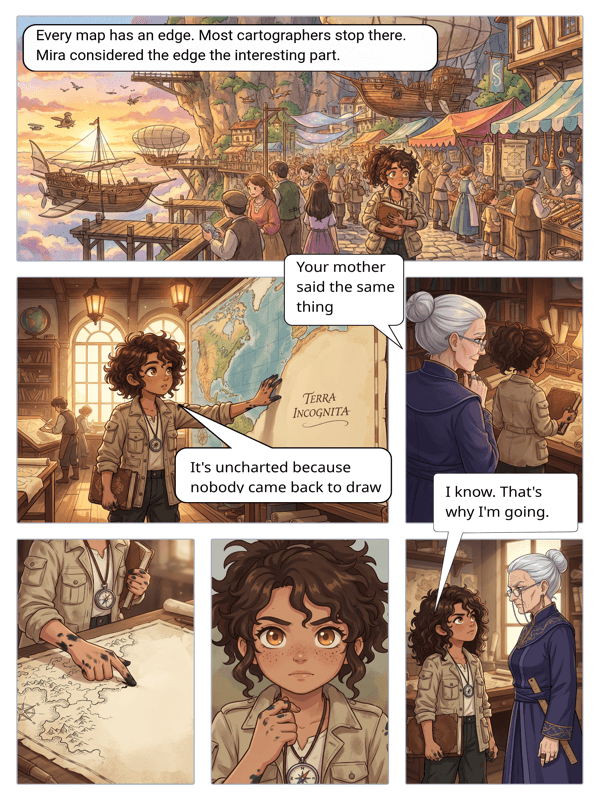
Search for a way to make a comic and almost everything you find is free. Free generators, free makers, free no-sign-up tools that turn a sentence into a strip in about twenty seconds. They are genuinely useful, and you should try them before you pay anyone anything.
They also all stop in the same place. Not at a paywall — at a structural limit. Knowing exactly where that limit sits saves you from the usual sequence: three days of re-generating the same character, then abandoning the project. Here is what free tools do well, precisely where they break, and how to tell which side of the line your project is on.
What free AI comic tools genuinely do well
Let us be fair about this, because the free tier is not a trap — it is the right choice for a real set of jobs.
- One good-looking panel, fast. Modern image models are excellent. A single comic-style image from a text prompt takes seconds and often looks great.
- Trying out a style. Want to know what your idea looks like as noir, or as manga? Free tools answer that in a minute, for nothing.
- A one-off joke or meme. Three panels, a punchline, no continuity required. Free tools are perfectly sized for this.
- Finding out whether you enjoy it. Genuinely the best use. Most people who think they want to make a comic have never made one.
If that is your project, stop reading and go use a free tool. Nothing below applies to you.
Where they stop: the same wall, every time
The wall is not features. It is that every panel is generated independently, and the tool has no memory of what it made a minute ago.
Describe "a red-haired detective in a long coat" and you get a red-haired detective in a long coat. Describe her again for panel two and you get a different woman who also has red hair and a coat. Different face, different age, different nose. Nothing is broken — the model was never told these two images were meant to be the same person, because it has no concept of a person that persists between prompts.
For one panel this does not matter at all. For a story it is fatal, because a comic is the same characters recurring. That is the entire form. A reader who cannot tell that panel one and panel eight show the same woman is not reading a story, they are looking at a collection of pictures.
This is why the failure mode is so consistent. People do not quit because a tool lacks a feature. They quit on page three, when they realise their protagonist has been four different people and there is no setting anywhere that fixes it.
The three things that follow from it
Character drift is the root problem, but it produces three others that show up right behind it:
- No page structure. Free generators output images, not pages. Panel layout, page order, and the rhythm of a page turn are all your problem, in some other application.
- Text baked into the art. Many free tools render dialogue directly into the image. It cannot be edited, it is frequently misspelled, and fixing a typo means regenerating the panel and losing the art you liked. Real lettering sits on its own layer above the art.
- No finished object. You end up with a folder of PNGs. Turning that into something a reader can actually read — in order, with a cover, at a link you can send someone — is a separate job in separate software.
Why "free" is the wrong axis
The instinct is to compare free tools against paid ones on price. That comparison misleads, because the two are not doing the same job. A free generator is an image tool. A comic needs a story tool. One is not a cheaper version of the other any more than a camera is a cheaper film studio.
The useful question is not "what does this cost" but "does this thing remember my characters?" Everything else — styles, layouts, export formats — is negotiable. That one capability is the line between a tool that can make a story and a tool that cannot, and it is worth checking before anything else.
Free tools are also not free of cost, just free of price. The cost lands as time: re-rolling the same panel twenty times hoping the face lands closer, then compositing the survivors by hand. That work is real, and it is the reason most free-tool comic projects have exactly one page.
How to tell which side of the line you are on
Answer honestly:
- Does the same character appear in more than about five panels?
- Will anyone other than you read it start to finish?
- Does it need to be more than one page?
- Would you be annoyed if you could not fix a typo without redrawing the panel?
All no: use a free tool, and enjoy it. Any yes: you are building a story, and you will hit the wall — the only question is how many hours you spend arriving there.
What a purpose-built tool actually changes
The difference is not more features bolted onto the same generator. It is that the character exists as an object before any panel does.
In YarnSaga you define a character once — appearance, costume, defining features — and the system generates a reference sheet for them. Every later panel is generated against that reference, so the same face and build appear on page one and page forty. You are not re-describing a person and hoping; you are pointing at one that already exists. The same applies to props and locations.
From there the rest follows: pages have layouts, dialogue goes into real speech balloons on their own layer that stay editable, and a finished story publishes to a link you can send someone. More on the mechanics in keeping AI comic characters consistent and in the guide to panel layout and reading order.
On cost, YarnSaga does not run a subscription. You buy credits once and they are valid for six months — a panel is about 0.3 credits, so a dollar is roughly three panels, and packs start at $6. If you stop for three months you pay nothing and your credits are still there. That model exists precisely because comic projects come in bursts.
The honest summary
Free AI comic tools are good at making images and bad at making comics, and that is not a criticism — it is what they were built for. If your project is one panel, one joke, or one experiment, they are the correct choice and paying for anything would be waste.
If your project has a character in it who needs to still be that character forty panels later, no amount of prompting gets you there, because the capability is not missing from the interface — it is missing from the architecture. Better to know that on day one than on page three.
Create your first story — no drawing skills needed
Characters stay consistent across every panel, automatically.
Request Early Access →More Articles
Explore YarnSaga